

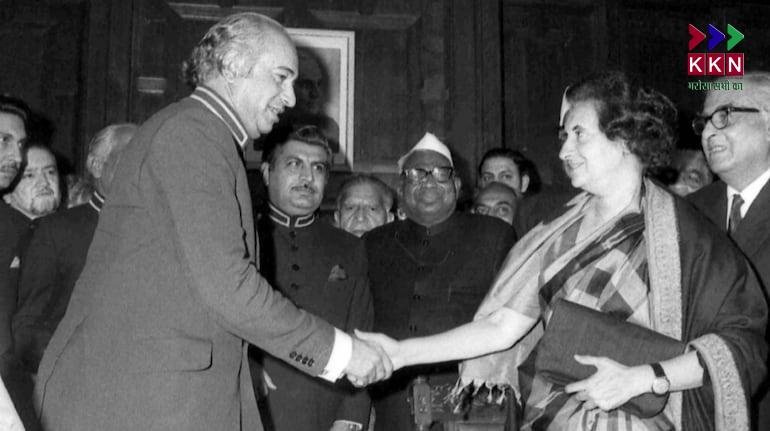
KKN Gurugram Desk | The Shimla Agreement, signed in 1972 between India and Pakistan, has once again come into the spotlight following recent threats from Pakistan regarding its potential cancellation. This historic agreement, signed after the decisive 1971 war, holds crucial importance in the diplomatic relationship between the two countries. Let’s explore the origins, significance, and potential implications of the Shimla Agreement in the present-day context.
Article Contents
Background of the Shimla Agreement
The Shimla Agreement was signed on July 2, 1972, in the aftermath of the 1971 India-Pakistan war, which led to the creation of Bangladesh. The agreement was a result of high-level discussions between Indian Prime Minister Indira Gandhi and Pakistani President Zulfikar Ali Bhutto. The key objective of the agreement was to normalize relations between the two nations, which had been severely impacted by the war.
One of the central provisions of the agreement was the recognition of the Line of Control (LoC) as the de facto boundary in Jammu and Kashmir. Both countries agreed to resolve issues through peaceful negotiations and reaffirmed their commitment to not use force to settle disputes.
Key Provisions of the Shimla Agreement
The Shimla Agreement focused on several important aspects of bilateral relations between India and Pakistan:
-
Recognition of the Line of Control (LoC): The agreement clearly defined the LoC as the official boundary in Jammu and Kashmir, thereby making it the agreed-upon demarcation between the two nations in the region.
-
Commitment to Peaceful Resolution: Both India and Pakistan committed to resolving disputes through peaceful dialogue rather than military confrontation. The agreement aimed to foster cooperation and reduce tensions between the two countries.
-
Prisoner of War Exchange: The agreement also ensured the release of prisoners of war and civilians detained during the 1971 war. It was an important humanitarian gesture aimed at healing the wounds of the conflict.
-
Territorial Integrity: Both countries pledged to respect each other’s territorial integrity and sovereignty. This provision emphasized the importance of diplomacy and dialogue in resolving disputes rather than resorting to violence.
The Significance of the Shimla Agreement
The Shimla Agreement was a major diplomatic breakthrough following the 1971 war. It marked a shift from military conflict to diplomatic engagement, offering hope for long-term peace between India and Pakistan. The agreement had several key implications:
-
Normalization of Relations: The Shimla Agreement played a significant role in stabilizing the relationship between India and Pakistan in the post-1971 era. It was seen as a step toward resolving longstanding issues and fostering peaceful coexistence.
-
Strengthening of India’s Position on Jammu and Kashmir: The recognition of the LoC as the official boundary in Jammu and Kashmir was a significant victory for India, as it formalized India’s control over the region. This provision became a cornerstone of India’s position on Kashmir in subsequent years.
-
International Diplomacy: The Shimla Agreement was also an important moment in international diplomacy. It demonstrated the willingness of both nations to resolve their differences through dialogue, which was seen as a positive development by the international community.
-
Humanitarian Impact: The exchange of prisoners of war and civilians helped heal the wounds of the 1971 conflict and facilitated the return of those who had been held captive.
Recent Developments: Pakistan’s Threat to Cancel the Shimla Agreement
In recent years, especially after a series of confrontations in Kashmir and the increasing tensions between India and Pakistan, Pakistan has raised the possibility of canceling the Shimla Agreement. This has brought the agreement back into the limelight.
Pakistan’s threats to revoke the agreement are seen as part of a broader attempt to challenge India’s position on Kashmir and escalate tensions in the region. The rhetoric surrounding the cancellation of the Shimla Agreement is often tied to ongoing military standoffs and diplomatic spats, particularly in the wake of incidents like the 2019 Pulwama attack and subsequent military strikes.
While such threats have been made in the past, it is important to recognize that canceling the Shimla Agreement would have significant diplomatic and geopolitical consequences for both countries.
Impact of Canceling the Shimla Agreement
-
Return to Military Confrontation: The Shimla Agreement was a crucial factor in preventing full-scale military conflict between India and Pakistan in the post-1971 period. If Pakistan were to revoke the agreement, it could lead to an escalation of tensions and possibly provoke another military confrontation.
-
Loss of Diplomatic Channels: The agreement served as a foundation for subsequent diplomatic engagements between the two countries. Its cancellation would remove a crucial framework for future negotiations, further complicating efforts to resolve issues like Kashmir through peaceful means.
-
International Implications: The international community, particularly the United Nations and major powers, has consistently supported the Shimla Agreement as a diplomatic solution to the Kashmir conflict. A revocation of the agreement would likely lead to condemnation and further isolation for Pakistan on the global stage.
-
Impact on Jammu and Kashmir: The Shimla Agreement’s recognition of the LoC as the official boundary in Jammu and Kashmir has been central to India’s stance on the region. A unilateral withdrawal from the agreement could alter the status quo and lead to a reevaluation of the region’s boundaries, potentially destabilizing the region further.
The Future of the Shimla Agreement
Despite the recent threats from Pakistan, the Shimla Agreement remains a cornerstone of India-Pakistan relations. It is unlikely that either country would want to completely discard the agreement due to the far-reaching consequences that would follow. However, the political climate in both nations remains volatile, and the future of the agreement will depend on the actions of both governments and the international community.
The key to maintaining peace and stability in the region lies in continued dialogue and adherence to the principles laid out in the Shimla Agreement. Both India and Pakistan have a shared responsibility to ensure that the agreement’s provisions are respected and upheld for the benefit of their citizens and the broader South Asian region.
The Shimla Agreement continues to be a critical part of the diplomatic framework between India and Pakistan. Signed in 1972, it set the stage for years of peace and stability between the two nations, offering a model for resolving disputes through dialogue and diplomacy. Despite the recent threats to cancel the agreement, the importance of the Shimla Agreement in maintaining peace and preventing military escalation cannot be overstated. It remains a symbol of the potential for resolution through negotiation and continues to shape the future of India-Pakistan relations.