

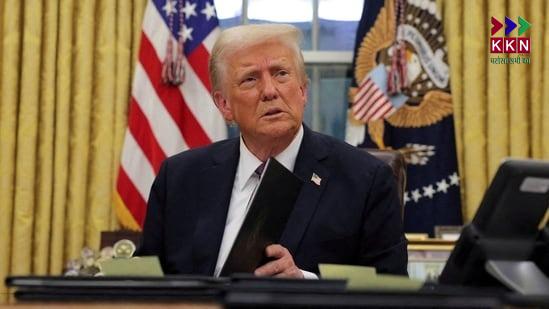
KKN Gurugram Desk | In a significant development in international trade, US President Donald Trump has announced a 90-day pause on tariffs imposed on several countries, excluding China. Instead of benefiting from the pause, China has been hit with a steep 125% tariff rate increase on its goods, escalating the already tense trade war between the two largest economies in the world. The news has sent ripples across global financial markets, with some countries seeing sharp market recoveries.
Article Contents
President Trump’s Decision to Exclude China From the Tariff Pause
On April 10, 2025, President Trump made the announcement of a 90-day pause on tariffs affecting various countries, which brought immediate relief to global markets, especially in Asia. However, China was notably excluded from this temporary relief, as President Trump imposed a drastic 125% tariff increase on Chinese goods. This escalation in tariff rates is seen as a direct response to China’s ongoing trade practices, which Trump has criticized in the past as unfair and harmful to the U.S. economy.
The Asian stock markets reacted positively to the broader tariff pause. The Nikkei 225 index in Japan surged by 8%, while South Korea’s Kospi index climbed more than 5%. The ASX 200 in Australia also saw a 5% rise during the early hours of trading. This boost reflects investor optimism over the potential de-escalation of the trade conflict between the United States and other trading partners, even though China’s exclusion from the tariff pause remains a critical issue.
The US-China Trade War: Tariff Rates and Countermeasures
President Trump’s decision to increase tariffs on Chinese goods by 125% is a move that escalates the ongoing trade war between the United States and China. The tariffs have been a contentious issue for months, with both sides imposing various measures on each other’s goods. Trump has accused foreign countries, including China, of levying harsh duties on American products and “plundering” the US economy. He argued that these trade imbalances have led to the loss of manufacturing jobs in the United States and have been detrimental to American businesses.
Following the announcement of the 125% tariff by President Trump, Beijing quickly responded with countermeasures. The Chinese government declared it would impose a retaliatory 84% tariff on US goods. This retaliatory move is seen as an effort by China to protect its interests and assert its position in the face of increasing pressure from the United States. The tariffs on US goods would affect a wide range of products, further exacerbating trade tensions and making it clear that neither side is willing to back down easily.
The ongoing conflict between the US and China has raised concerns in global markets, especially as both countries are vital trading partners for many economies. The introduction of such high tariff rates further complicates the economic relationship between the two powers and poses risks for global trade.
Global Market Reactions: Sharp Rallies and Uncertainty
The US stock market has been significantly impacted by the ongoing trade war, with investors often reacting to announcements from President Trump regarding tariffs and trade policies. The announcement of the 90-day tariff pause on April 9, 2025, led to a sharp rally in US stocks, as investors interpreted the decision as a potential signal of de-escalation in the trade conflict. The Dow Jones Industrial Average soared by 2,962.97 points, or 7.87%, closing at 40,608.56, while the Nasdaq Composite surged by 1,867.06 points, or 12.16%, reaching 17,124.97. The S&P 500 also experienced significant gains, climbing 474.93 points, or 9.53%, to reach 5,456.20.
These market movements reflect investor optimism that the pause in tariffs, even if temporary, could lead to stability in international trade relations. The rally in US stocks has provided some relief after the uncertainty caused by President Trump’s earlier tariffs on various goods. However, this optimism is tempered by the ongoing trade tensions with China, as the 125% tariff increase on Chinese goods remains a point of concern.
While these sharp market movements are welcome news for many investors, they also highlight the volatility in the global financial system. The stock markets have become accustomed to wide fluctuations, not just day to day but hour by hour, as traders and investors struggle to understand the long-term economic impact of Trump’s trade war policies.
Trump’s Trade War: The Impact on Global Financial Markets
The US-China trade war has been one of the key drivers of uncertainty in global financial markets. As both countries impose tariffs on each other’s goods, the ripple effect has been felt by economies worldwide. Countries that are major trading partners of the US and China have seen their stock markets fluctuate based on the ongoing developments.
In particular, the Asian markets have been more sensitive to the announcements related to the US-China tariffs. When President Trump announced the 90-day pause on tariffs, the Asian markets bounced back sharply, with Japan, South Korea, and Australia all seeing significant increases in their stock indices. This rebound is seen as a reflection of investor confidence that the broader trade dispute may ease, allowing for better economic conditions in the region.
However, the 125% tariff on Chinese goods remains a serious concern, particularly for Chinese companies that rely heavily on exports to the United States. The retaliatory measures from China, including the imposition of 84% tariffs on US goods, will further strain the bilateral trade relationship and increase the cost of goods on both sides.
The Long-Term Impact of Trump’s Tariffs on the Economy
The long-term impact of Trump’s tariffs on the global economy remains uncertain. While the 90-day tariff pause is seen as a positive sign, many economists warn that the broader implications of a protracted trade war could hurt global growth. China’s response, along with the US’s continued tariff policies, could lead to slower trade flows, higher prices for consumers, and disrupted supply chains.
Moreover, the increase in tariffs on Chinese goods could lead to higher costs for US consumers. Many everyday goods, including electronics, clothing, and appliances, are manufactured in China, and higher tariffs on these products would likely result in price increases in the US market. This could lead to inflationary pressures and affect the purchasing power of US consumers.
In the long run, the uncertainty surrounding the US-China trade dispute could prompt businesses to rethink their global supply chains, potentially leading to a shift away from China as a manufacturing hub. This would have significant implications for industries that rely on Chinese manufacturing and could result in the restructuring of global supply chains.
As the 90-day tariff pause takes effect, the global community will be closely watching how the trade tensions between the US and China evolve. While the tariff pause has provided some relief to global markets, the 125% tariff increase on Chinese goods is a stark reminder that the trade war is far from over. The situation remains fluid, and the financial markets are likely to experience continued volatility as investors react to new developments.
The next few months will be crucial in determining the future trajectory of the US-China trade war and its impact on the global economy. As the two economic giants continue to clash over tariffs and trade policies, the world’s financial markets will remain on edge, waiting for any signals of resolution or escalation in the dispute.