

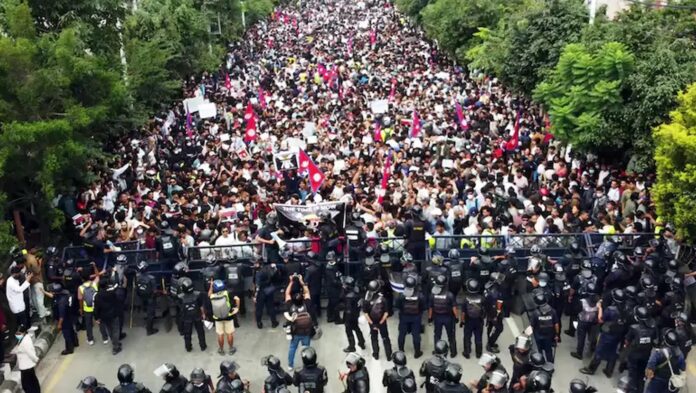
Nepal is witnessing one of its most serious political and social crises in recent years. Violence erupted in Kathmandu and surrounding areas after public anger over corruption allegations and restrictions on social media platforms boiled over. On Monday, thousands f protesters, many from Generation Z, stormed the streets and clashed with security forces.
Article Contents
According to reports, 19 demonstrators were killed in police firing, while many others were injured. The incident has placed Prime Minister KP Sharma Oli’s government under immense pressure. The resignation of Home Minister Ramesh Lekhak has not eased the unrest, as protesters continue to demand accountability at the highest level.
Protests Fueled by Social Media Restrictions and Corruption Allegations
The immediate trigger for the demonstrations was the government’s decision to block several social media platforms. Citizens, particularly young people, saw the move as an attack on freedom of expression. At the same time, long-standing accusations of corruption against political leaders added to the public outrage.
Protesters gathered in massive numbers in Kathmandu, chanting slogans against the government and demanding transparency. Several groups attempted to enter Parliament, leading to violent clashes with security forces. When police opened fire, the protests turned deadly, leaving dozens dead or injured.
Government in “Surrender Mode” After Deadly Violence
The deaths caused by police firing have left the government facing criticism from all directions. Prime Minister KP Sharma Oli tried to ease tensions by announcing plans to lift restrictions on social media. Shortly afterward, Home Minister Ramesh Lekhak resigned, accepting moral responsibility for the violence.
Despite these steps, the protesters refused to back down. Generation Z demonstrators argued that the Prime Minister himself must resign, as the responsibility for the bloodshed ultimately lies with him.
Oli Defends Government Actions
Prime Minister Oli addressed the nation, attempting to defend the government’s handling of the protests. He argued that the demonstrations were initially peaceful but were hijacked by disruptive elements. According to him, these infiltrators created chaos and forced the government to take tough measures.
“We acted to protect constitutional institutions,” Oli said. “Unfortunately, the situation escalated, and innocent lives were lost. Our government values the aspirations of the younger generation and remains committed to addressing their concerns.”
He also insisted that the government never intended to permanently block social media. However, he pointed out that many platforms had not registered within Nepal, raising concerns about regulation.
Investigations Announced into Deaths and Violence
The government has announced that an independent investigation will examine the incidents of violence and deaths in Kathmandu and other cities. Officials claim that the inquiry will determine whether police action was excessive and who should be held accountable.
The decision to launch an investigation has not convinced the protesters. They continue to occupy streets, demanding concrete steps instead of promises. For many, the resignation of the Home Minister is symbolic but insufficient.
Generation Z at the Heart of the Movement
The protests have been led largely by young citizens, many of them college students and first-time voters. Generation Z has become increasingly vocal about corruption, governance, and freedom of speech in Nepal.
Demonstrators say they are tired of old political practices and want a system that reflects their aspirations. Their demands include full internet freedom, transparency in public contracts, and stronger accountability from politicians.
By targeting the Vice President and Prime Minister directly, protesters are signaling that they are unwilling to accept superficial changes.
Social Media Ban Sparks Wider Debate
The government’s decision to block popular social media platforms played a central role in igniting the unrest. Platforms such as Facebook, Twitter, and TikTok are widely used in Nepal, particularly among the youth.
Prime Minister Oli has claimed that the decision was temporary and driven by regulatory concerns. He emphasized that the policy of his administration is not to block social media, but to ensure that platforms comply with Nepalese laws.
Despite his assurance, protesters see the move as an attempt to silence dissent. Analysts argue that in a country where youth engagement is largely online, blocking social media is seen as an attack on personal freedoms.
Cabinet Meeting and Political Fallout
Following the deadly violence, Oli convened a cabinet meeting to review the situation. Ministers discussed the growing public anger and the political risks for the government. The resignation of Home Minister Ramesh Lekhak was seen as a step to contain the crisis, but it failed to calm the streets.
Opposition parties have seized the opportunity to criticize the ruling government. They accuse Prime Minister Oli of failing to handle the protests with sensitivity and escalating the crisis through force.
Public Perception of Oli’s Leadership
Oli has long projected himself as a strong leader, but his handling of the protests may weaken that image. Critics say his government underestimated the anger of young citizens and over-relied on police action.
By trying to frame the protests as infiltrated by “anarchist elements,” Oli risks alienating genuine demonstrators who were demanding peaceful reforms. Political commentators warn that such a narrative could deepen the divide between the government and the youth.
International Concerns Over Human Rights
The death of 19 protesters in police firing has attracted global attention. International human rights organizations have urged Nepal to show restraint and respect the right to peaceful protest. Statements from regional partners are expected, as Nepal’s stability is vital to South Asia.
The UN and several Western embassies are monitoring the situation closely. Any escalation of violence could harm Nepal’s global image and discourage foreign investment at a time when the economy is struggling.
The Road Ahead for Nepal
The immediate question is whether Prime Minister KP Sharma Oli can weather this crisis. His concessions, including lifting social media restrictions and accepting a ministerial resignation, have not satisfied protesters. Calls for his resignation are growing louder, and political opponents are intensifying pressure.
The government must balance maintaining law and order with respecting democratic rights. Excessive force risks further inflaming tensions, while inaction could embolden agitators.
Nepal’s Generation Z has made it clear that they are determined to shape the country’s future. Their sustained mobilization suggests that this movement is not a passing wave but part of a larger demand for change.
The violence in Kathmandu and the deaths of 19 protesters mark a turning point in Nepal’s democratic journey. With the youth demanding accountability and the government struggling to respond, the crisis highlights deep divisions within society.
How the government responds in the coming days will shape public trust in institutions. If Oli can rebuild confidence and open dialogue with protesters, stability may return. But if repression continues, Nepal may face prolonged unrest.