


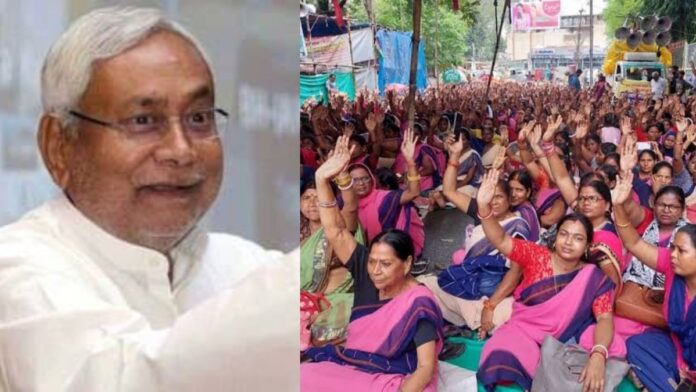
Ahead of the Bihar Assembly Elections 2025, Chief Minister Nitish Kumar has announced a major decision for thousands of Anganwadi Sevikas and Sahayikas working across the state. The Bihar government has approved a salary hike for these frontline workers who play a crucial role in the implementation of welfare schemes. This step is being seen as an important political and social move before the elections.
Article Contents
According to the announcement, the monthly honorarium of Anganwadi Sevika has been increased from 7,000 rupees to 9,000 rupees. Similarly, the honorarium of Anganwadi Sahayika has been raised from 4,000 rupees to 4,500 rupees. This increase in salary is expected to directly benefit thousands of women working in the Anganwadi system across rural and urban Bihar.
Nitish Kumar’s announcement and political timing
Chief Minister Nitish Kumar shared this decision through his official account on X and emphasized that the role of Anganwadi workers in Bihar has been essential for child nutrition, maternal health, and overall community development. The timing of this announcement has drawn attention, as it comes just months before the state goes into assembly elections. Political experts believe that this move is aimed at strengthening Nitish Kumar’s support base among women voters.
Nitish Kumar highlighted that ever since his government took charge in November 2005, special focus has been given to the welfare of pregnant women and children. The government has consistently tried to improve nutrition levels, reduce child mortality, and provide healthcare support at the grassroots level. Anganwadi workers have been at the center of these efforts, implementing six types of services under the Integrated Child Development Services (ICDS) scheme.
Role of Anganwadi Sevikas and Sahayikas in Bihar
Anganwadi Sevikas and Sahayikas serve as the backbone of child and maternal welfare schemes in Bihar. They are responsible for running Anganwadi centers, where children under the age of six, along with pregnant and lactating women, receive essential health and nutrition support. From distributing nutritional food to monitoring child growth, from spreading awareness about hygiene to encouraging institutional deliveries, their duties cover a wide range of responsibilities.
Nitish Kumar acknowledged these contributions and stated that the salary increase is a recognition of their tireless work. By enhancing their honorarium, the government aims to boost their morale and motivate them to continue serving with dedication. The Chief Minister further mentioned that this increase will improve the delivery of Integrated Child Development Services across the state.
Financial impact of the decision
The salary hike for Anganwadi workers is expected to have a significant financial impact on the state exchequer. However, the government views it as a necessary investment in human resources that are vital for the implementation of welfare policies. The decision will require additional budgetary allocations, but it also reinforces the message that the state values the contribution of women working at the grassroots level.
Political analysts point out that while the hike in honorarium may appear modest, the symbolic value of this announcement is far greater. It sends a message to Anganwadi workers and their families that the government recognizes their efforts and is willing to improve their working conditions.
Women voters as a key focus in Bihar elections
In Bihar’s electoral politics, women voters have become a decisive factor over the last two decades. Nitish Kumar’s earlier schemes such as bicycle distribution for school girls, reservation for women in panchayats, and prohibition on alcohol were also seen as measures to attract women voters. The recent hike in salaries for Anganwadi Sevikas and Sahayikas fits into this larger political strategy.
By strengthening the economic standing of these women, many of whom belong to rural and marginalized communities, the government hopes to create a ripple effect that will reach their families and communities. With the 2025 assembly elections drawing closer, the move could play a role in shaping voting patterns in several constituencies.
Anganwadi workers’ demands and challenges
For years, Anganwadi workers across Bihar have been demanding a hike in honorarium, better working conditions, and recognition as government employees. They have held protests and strikes in the past, pointing out that their workload often far exceeds their pay.
Many Sevikas and Sahayikas have highlighted the difficulty of managing household responsibilities alongside long hours at Anganwadi centers. In rural areas, the lack of proper infrastructure and resources further adds to their challenges. While the recent hike is a step in the right direction, workers’ unions are expected to continue pressing for more significant reforms, including permanent employment status and social security benefits.
Integrated Child Development Services in Bihar
The Integrated Child Development Services scheme has been one of the largest community-based outreach programs in Bihar. It provides a package of six services, including supplementary nutrition, preschool education, health check-ups, immunization, referral services, and health and nutrition education. These services are delivered primarily through Anganwadi centers, which function under the guidance of Sevikas and Sahayikas.
Nitish Kumar, in his message, reiterated that these services have been instrumental in improving the health and nutrition levels of children and pregnant women in Bihar. By increasing the salaries of workers involved, the government aims to strengthen the functioning of these centers and make the scheme more effective.
Social and political reactions to the announcement
The announcement of the salary hike has already started to generate responses from different quarters. Women’s organizations and welfare groups have welcomed the decision, describing it as a recognition of women’s contribution to society. On the other hand, opposition parties have termed it as an election-oriented move, aimed at securing votes rather than addressing the larger issues faced by Anganwadi workers.
Several political commentators believe that while the hike is limited, it may still have a positive impact on the perception of the government among women. Considering that Anganwadi workers often interact directly with communities at the village level, their improved morale could also translate into stronger outreach for welfare schemes.
Long-term implications for Bihar
Beyond the electoral implications, the salary hike for Anganwadi workers can have long-term benefits. Higher income can improve the financial stability of families dependent on these honorariums. When women earn more, the benefits often extend to better education and healthcare for their children.
Moreover, motivated Anganwadi workers can ensure better implementation of health and nutrition programs. This could reduce malnutrition rates, improve maternal health, and contribute to overall human development indicators in Bihar. In a state where poverty and undernutrition remain challenges, the role of Anganwadi centers continues to be vital.
Nitish Kumar’s focus on women empowerment
Over the years, Nitish Kumar has consistently highlighted women empowerment as a priority area of his governance. From the cycle scheme for girls to 50 percent reservation in local bodies, from enforcing prohibition to schemes for women entrepreneurs, his policies have aimed at strengthening the role of women in Bihar’s society.
The salary hike for Anganwadi Sevikas and Sahayikas is in line with this vision. It not only supports women workers financially but also acknowledges their role in shaping the health and future of the next generation. By linking governance with women-centric policies, the Chief Minister continues to build a narrative of inclusive development.
The decision to increase the honorarium of Anganwadi Sevikas from 7,000 to 9,000 rupees and that of Anganwadi Sahayikas from 4,000 to 4,500 rupees is both a welfare measure and a political strategy. It reflects the government’s acknowledgment of the crucial role played by these workers in child and maternal welfare.
As Bihar heads into assembly elections in 2025, the move is likely to resonate with thousands of women voters and their families. Whether it translates into electoral gains remains to be seen, but the immediate effect will be an improvement in the morale of Anganwadi workers who form the backbone of grassroots welfare delivery.
By investing in the people who serve at the community level, the government not only strengthens its political base but also takes a step toward building a healthier and more empowered Bihar.


Discover more from
Subscribe to get the latest posts sent to your email.