

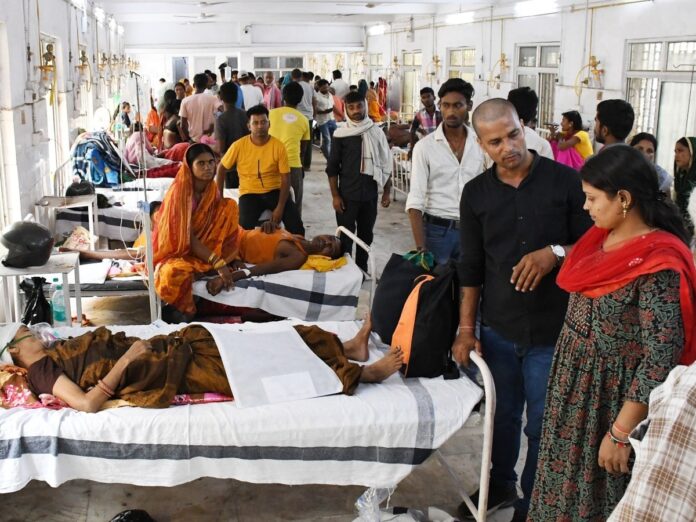
In Bihar, a disturbing incident has raised serious questions about healthcare. The Sri Krishna Medical College and Hospital (SKMCH) in Muzaffarpur is known as a premier government institution. Yet, on Wednesday, its emergency ward witnessed a shocking case of medical negligence.
Article Contents
A critically injured woman, identified as Rehana Khatoon from Manikpur village under Kanti police station, was brought to the hospital. She was in severe pain, suffering from head injuries caused by a violent clash in her village. Despite her condition, doctors allegedly refused to provide treatment. Instead, they demanded a referral slip from a primary health center or sadar hospital before proceeding.
Delay in Treatment Sparks Outrage
Family members said they pleaded repeatedly with doctors in the emergency ward. However, no senior physician attended the patient for almost an hour. Finally, an intern doctor arrived and examined Rehana briefly. Shockingly, she advised the family to get a referral from the sadar hospital and then left without offering treatment.
As Rehana continued to groan in pain, her relatives grew furious. The situation escalated into arguments between the patient’s family and hospital staff. Eventually, the family decided to take her to another hospital after her condition worsened. This sequence of events has ignited outrage in Muzaffarpur, with locals questioning the conduct of SKMCH doctors.
Family’s Version of Events
Relatives of the injured woman told hospital police that the injuries occurred during a village dispute. A physical altercation had left Rehana with a serious head wound. After registering at the counter, they rushed her to the emergency ward, expecting urgent care.
Instead, the attending doctor asked them to first bring a referral slip from the primary health center. The family alleged that repeated calls to hospital managers went unanswered. Frustrated and helpless, they were left with no choice but to move Rehana elsewhere.
Official Response and Hospital Silence
While the hospital administration largely remained silent on the controversy, Deputy Superintendent Dr. Satish Kumar Singh responded briefly. He claimed he had no prior knowledge of the incident. He also stated that emergency wards are duty-bound to treat any patient first and handle formalities later.
The family has filed a complaint with Bihar’s Health Minister Mangal Pandey, demanding strict action against those responsible. They also pointed out that such negligence is not new at SKMCH. According to them, emergency patients are often denied immediate treatment, pushing them towards private hospitals.
The Role of Middlemen and Private Hospitals
Locals allege that SKMCH has long been plagued by the presence of middlemen. These brokers keep a constant watch on incoming emergency patients. They allegedly collaborate with ambulance drivers to divert patients to nearby private hospitals.
Reports suggest that SKMCH is surrounded by hundreds of private clinics and hospitals. Many families claim they were pressured into shifting patients under the pretext of poor facilities or deliberate delays at SKMCH. This practice has created a parallel market, exploiting the desperation of patients in need of urgent care.
Questions About Accountability
The latest incident has sparked wider debates about accountability in Bihar’s public healthcare. SKMCH, one of the largest government hospitals in North Bihar, is supposed to be a lifeline for critical patients. Yet, repeated allegations of negligence undermine public trust.
Healthcare experts stress that emergency wards are obligated to treat patients immediately. Referral procedures are meant for organized transfers, not for denying life-saving treatment. The refusal to attend to a bleeding patient goes against fundamental medical ethics.
A Pattern of Negligence
According to patient families and activists, this is not an isolated case. They allege that SKMCH emergency has witnessed several such incidents in recent months. Many believe that delays are deliberate, forcing patients to opt for private treatment.
In this case, the injured woman’s family strongly believes the refusal to treat was part of a larger pattern. They argue that private hospitals benefit from such practices, while poor families suffer unbearable financial and emotional strain.
Broader Healthcare Concerns
Bihar’s healthcare system has often been in the spotlight for inefficiency. Despite government efforts, hospitals continue to face shortages of doctors, staff, and equipment. At SKMCH, which serves a large population, pressure on resources is immense. However, negligence in emergency wards cannot be justified under any circumstances.
Observers argue that strict monitoring and accountability mechanisms are essential. Without them, patients will continue to face delays in critical care. The growing dominance of private hospitals near SKMCH further complicates the issue.
Political and Public Reactions
The family’s complaint to Health Minister Mangal Pandey has brought the issue into the political sphere. Opposition parties are expected to use it as an example of government failure in healthcare. For ordinary citizens, the case reinforces deep frustration with public hospitals.
Local residents have called for a transparent inquiry into the incident. Many demand that guilty doctors face suspension or termination. Social activists insist that referral slips should never be a condition for emergency care.
SKMCH’s Reputation at Stake
Sri Krishna Medical College and Hospital is one of Bihar’s most reputed institutions. Any controversy involving patient neglect damages its image further. With hundreds of cases arriving daily, the hospital remains under scrutiny.
This latest case raises questions about whether SKMCH is prioritizing patients or allowing informal systems to dictate care. Its silence on the issue has only deepened suspicions among the public.
Ethical Questions for Doctors
Doctors are often referred to as “God on Earth” for saving lives. Yet, the refusal to treat a woman in pain has shaken this perception. Medical ethics clearly emphasize the duty to attend emergencies without delay.
Critics argue that such negligence tarnishes the medical profession itself. While systemic issues cannot be ignored, individual accountability is equally important. Every doctor in emergency care carries the responsibility to protect life first.
The Need for Reform
The case of Rehana Khatoon underscores the urgent need for reforms at SKMCH. Strict guidelines must ensure that no patient is denied emergency care. Whistleblower mechanisms can help expose malpractice and the role of middlemen.
At the policy level, the government must strengthen public hospitals to reduce dependence on private institutions. Investment in infrastructure, staffing, and monitoring will be essential to rebuild trust.
The painful experience of Rehana Khatoon has highlighted deep cracks in Bihar’s healthcare. A premier hospital like SKMCH denying treatment without a referral slip is both shocking and unacceptable.
The government, hospital administration, and medical fraternity must address this urgently. Accountability and reform are essential if public hospitals are to serve their intended purpose. For patients and families, the hope remains that hospitals act as saviors, not gatekeepers.
This incident should serve as a wake-up call for authorities. Without immediate corrective steps, Bihar’s healthcare crisis will only deepen, and public faith will erode further.