

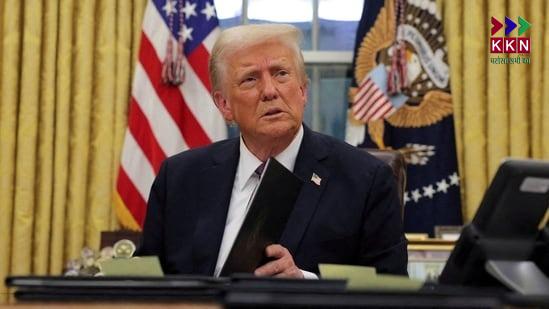
KKN Gurugram Desk | In a bold political and economic statement, former U.S. President Donald Trump has urged Apple CEO Tim Cook to immediately stop the company’s manufacturing operations in India. The demand, which Trump revealed during a diplomatic visit to Qatar, appears to be a strategic move aimed at realigning Apple’s supply chain back to the United States—a shift that could deeply impact Apple’s India strategy and broader global manufacturing landscape.
Article Contents
Speaking about a recent conversation with Tim Cook, Trump said, “I had a bit of a problem with Tim yesterday. He’s building all over India. I told him, ‘I don’t want you to do any building in India.’” Trump asserted that Apple should scale up its U.S. production and reduce dependency on countries like India and China, reinforcing his long-standing agenda of bringing jobs back to American soil.
India in the Crosshairs: Why Trump Is Targeting Apple’s Expanding Base in India
Apple has significantly increased its manufacturing footprint in India in recent years. As of March 2025, the company had assembled iPhones worth over $22 billion in India—marking a nearly 60% year-over-year increase in production.
Much of this manufacturing is executed through partnerships with major global suppliers like Foxconn Technology Group, Tata Electronics, and Pegatron Corp. These suppliers have been expanding their production capabilities in South India to meet Apple’s growing demands and to diversify beyond China due to mounting geopolitical and trade tensions.
However, Trump’s latest remarks signal potential roadblocks to this momentum.
Geopolitical Strategy or Protectionism? Trump’s America-First Manufacturing Agenda
Donald Trump has consistently championed protectionist economic policies, particularly during his tenure as President. His latest comments fit within that broader narrative—pushing U.S. corporations to reduce overseas dependencies and revive domestic industrial output.
He also criticized India’s high import duties on American products, stating, “India has some of the highest tariff barriers in the world. It’s extremely difficult to sell American products there.” While acknowledging India’s recent willingness to negotiate tariff reductions, Trump appeared skeptical of the long-term benefits.
The timing of these statements is crucial. Apple has been gradually decreasing its reliance on China, especially after the 2020–21 pandemic and increasing tensions between Beijing and Washington. Tariffs imposed during Trump’s own administration, along with China’s zero-COVID policy, had already begun to reshape Apple’s global supply chain.
The Strategic Rise of India in Apple’s Supply Chain
India has increasingly emerged as a central player in Apple’s manufacturing plans. The company began assembling iPhones in India back in 2017 and has since scaled operations significantly.
Key developments include:
-
Foxconn, Apple’s largest contract manufacturer, has established a major facility in Sriperumbudur, Tamil Nadu, responsible for assembling a significant portion of iPhones sold domestically and exported.
-
Tata Group, through its acquisition of Wistron Corp’s operations, is now a major local manufacturer. The conglomerate is also in talks to become a direct supplier to Apple—an unprecedented move for an Indian firm.
-
Pegatron also maintains active assembly lines in South India, further strengthening Apple’s network.
India’s appeal lies in its large labor force, growing infrastructure, and political stability compared to volatile environments like China. Additionally, India offers favorable government incentives under schemes such as the Production Linked Incentive (PLI) program, designed to attract global manufacturers.
Apple’s Balancing Act: Navigating U.S. Politics and Global Supply Chains
Apple finds itself in a delicate balancing act. On one hand, it must navigate mounting political pressure from the U.S., particularly from figures like Trump who advocate for reshoring production. On the other hand, it must maintain operational efficiency and global competitiveness—both of which are heavily reliant on diverse international supply chains.
Apple has no current smartphone production facilities in the United States. Nearly all iPhones are made overseas, primarily in China and increasingly in India. Building manufacturing capacity in the U.S. would require significant capital investment, regulatory adjustments, and training of a skilled labor force—factors that make rapid transition difficult.
Despite Trump’s assertion that Apple will now increase production in the U.S., the company has not officially confirmed any shift in its India operations. Industry insiders suggest that a full-scale move back to the U.S. is unlikely in the short term.
Economic Implications: What Would an Apple Exit Mean for India?
If Apple were to reduce its manufacturing footprint in India, the economic consequences could be significant:
-
Job Losses: Thousands of workers are employed directly and indirectly through Apple’s supplier network in India.
-
Investor Sentiment: Apple’s presence is seen as a validation of India’s potential to become a global manufacturing hub. A rollback could dent investor confidence.
-
Export Goals: Apple’s production contributes substantially to India’s electronics export targets. Losing this momentum could hinder growth.
-
Technology Transfer: Localized manufacturing brings not just jobs but also skills and technological know-how that benefit the broader economy.
India, which aspires to become a leading alternative to China in electronics manufacturing, could face strategic setbacks if major players like Apple scale down investments.
What Drives Trump’s Stance? Trade Imbalance, Domestic Politics, and Global Power Plays
Trump’s protectionist stance isn’t new. His administration levied billions in tariffs on Chinese goods and penalized companies that offshored jobs. His comments on India appear to extend that logic—criticizing what he sees as unfair trade practices and urging American companies to remain loyal to domestic interests.
In the lead-up to another potential presidential run, Trump may be using Apple’s overseas operations as a political talking point to galvanize nationalist sentiment and manufacturing workers. By framing Apple’s global strategy as unpatriotic or misaligned with American interests, he taps into a growing anti-globalization narrative in the U.S.
Can the U.S. Realistically Become a Smartphone Manufacturing Hub?
While Trump’s demands may resonate politically, industry experts question their practicality. Building and scaling smartphone manufacturing in the U.S. faces numerous hurdles:
-
Higher Labor Costs: U.S. labor costs are significantly higher than in India or China.
-
Supply Chain Complexity: Components are sourced globally; assembling them domestically may increase lead times and costs.
-
Lack of Infrastructure: Unlike Asia, the U.S. lacks a robust electronics manufacturing ecosystem for end-to-end smartphone production.
-
Talent Shortages: Skilled labor in precision electronics manufacturing is limited in the U.S.
Some manufacturing may be feasible for niche or high-end devices, but mass-market production, as seen in Asia, remains economically challenging in the current setup.
India’s Strategic Response: Strengthening its Position in Global Tech Supply Chains
In response to such uncertainties, India is likely to double down on incentives, policy reforms, and diplomatic engagement to retain and attract high-tech manufacturing. Initiatives could include:
-
Enhanced PLI Schemes for electronics and semiconductor manufacturing.
-
Faster regulatory clearances and infrastructure development.
-
Investment in skilling the workforce to meet global standards.
-
Bilateral trade negotiations with the U.S. to resolve tariff issues.
India’s long-term strategy hinges on building self-reliance in electronics while serving as a global export hub—a goal that could be jeopardized if major foreign investments are reversed under political pressure.
Donald Trump’s directive to Apple to stop building iPhones in India underscores the growing politicization of global supply chains. Whether this statement translates into actionable change or remains a symbolic gesture remains to be seen.
For now, Apple continues to expand its India operations, with suppliers like Foxconn and Tata ramping up capacity. But with the specter of U.S. political pressure looming large, the company must tread carefully—balancing economic logic with geopolitical realities.